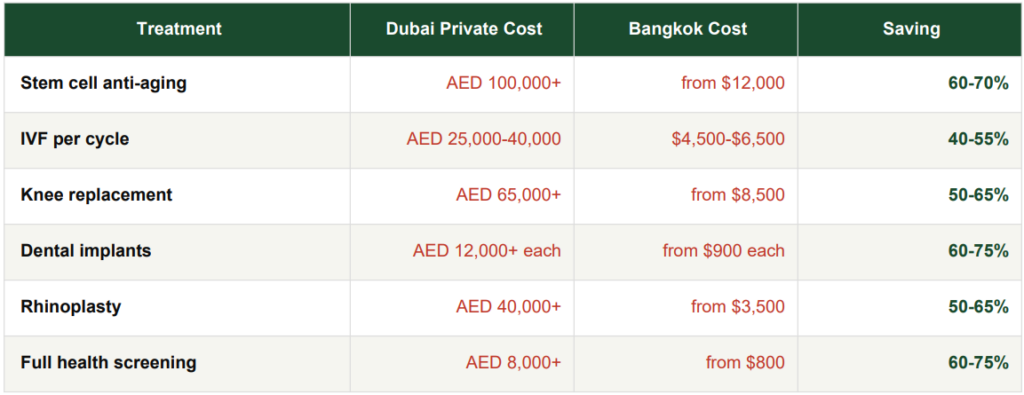
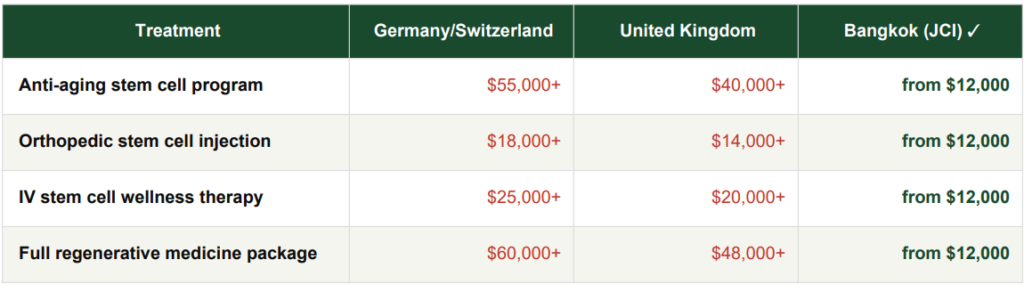
Stem cell therapy in Bangkok costs significantly less than the same treatment in Germany, Switzerland, or the United Kingdom — and for patients from the Middle East, UK, and Australia, this difference often makes Bangkok the only realistic option. This article breaks down the real costs, explains what is included, and tells you exactly what to expect before you book anything.
What Does Stem Cell Therapy Cost in Bangkok?
Stem cell therapy in Bangkok starts from $12,000 USD per program. The final cost depends on three factors: the type of stem cells used, the number of sessions in your protocol, and the condition being treated.
All Bangkok programs are conducted at JCI-accredited private hospitals by internationally trained specialists.
The price difference is driven by lower operating costs in Thailand — not by any difference in clinical quality, equipment, or expertise.
Why Is Stem Cell Therapy So Much Cheaper in Bangkok?
The cost difference reflects three economic realities — not quality differences:
- Operating costs in Thailand are significantly lower — hospital running costs, staff salaries, andpropertyarea fraction of European equivalents.
- No insurance overhead — Thai private hospitals deal primarily with self-paying international patients, removing the administrative burden that inflates Western healthcare costs.
- Government support for medical tourism — Thailand has invested heavily in its medical destination status, keeping regulatory costs lower for internationally accredited hospitals.
The result: a JCI-accredited Bangkok hospital can offer the same stem cell treatment protocol — using the same cell sources, same equipment, and doctors with equivalent international training — at a fraction of the European prices.
What Is Included in the Bangkok Price?
- Initial consultation and full medical assessment
- Pre-treatment blood work and laboratory testing
- Stem cell preparation and laboratory processing
- Treatment sessions — IV infusion or targeted injection
- Post-treatment monitoring and medical review
- Full medical documentation for your home country doctor
Travel, accommodation, and airport transfers are arranged separately by Well Journey Global at no additional coordination fee. Our service is provided at zero extra cost to you — we earn a referral fee from the hospital.
What Type of Stem Cells Are Used?
Autologous Stem Cells
Collected from your own body — typically from bone marrow or fat tissue. Zero rejection risk. Commonly used for orthopedic applications and certain immune conditions.
Allogeneic Stem Cells (Umbilical Cord Blood)
Ethically donated after birth, processed and certified by accredited cell banks. Rich in young, potent stem cells. Widely used for anti-aging and systemic wellness programs.
Placental Tissue
Exceptionally high in growth factors. Used in advanced longevity and regenerative programs. All sources are ethically obtained and laboratory certified.
Is the Lower Cost a Safety Concern?
No — when you choose a JCI-accredited hospital. JCI (Joint Commission International) is the same certification held by leading hospitals in the US and Europe, assessed on over 1,200 international standards covering patient safety, infection control, staff qualifications, and facility management.
What to avoid:
- unlicensed clinics offering treatment without prior medical assessment, unclear cell sourcing, or unusually
- low prices with no explanation. Well Journey works exclusively with JCI-accredited hospitals we have personally visited and verified.
Frequently Asked Questions
How long does a stem cell therapy program take in Bangkok?
Most programs last 3–7 days in Bangkok. Some single-session treatments can be completed in 1–2 days, while comprehensive anti-aging programs may require up to 2 weeks.
When will I see results?
Anti-aging and wellness patients typically report improvements in energy, sleep, and cognitive clarity within 4–8 weeks. Orthopedic patients typically notice pain and mobility improvements within 6–12 weeks.
Is the coordination service really free?
Yes. Well Journey earns a referral fee from the hospital — not from you. You pay the hospital directly at their standard rate.